What Are the Challenges Facing Cloud Data Centers?
First, what is a cloud data center?
A cloud data center is a facility that houses the compute, storage and networking resources used to deliver cloud-based applications and services over the internet. Unlike traditional enterprise data centers built mainly for a single organization, cloud data centers are designed for scale, flexibility and rapid change. They must support massive volumes of traffic, frequent technology upgrades and increasingly demanding workloads—including AI—while maintaining performance, uptime and efficiency.
That combination of scale and speed is exactly why cloud data centers face growing infrastructure pressure. As CommScope explains on our data center solutions pages, modern facilities are operating in a constant state of transition, driven by the need for higher speeds, denser architectures and the flexibility to evolve without creating dead ends in the physical layer. For cloud operators, the challenge is not only meeting current demand, but also building an infrastructure foundation that can adapt to what comes next.
The Challenges
1. Scaling for higher density and faster speeds
One of the biggest challenges facing cloud data centers is the relentless push toward higher density and faster data rates. AI workloads, hyperscale growth and bandwidth-heavy applications are accelerating the move to 400G, 800G, 1.6T and beyond, putting enormous pressure on the physical layer. More fibers, more interconnects and tighter rack footprints can quickly create congestion, increase complexity and make future migrations harder if the infrastructure was not designed with scalability in mind.
This is where CommScope solutions deliver critical advantages: high-density, ultra-low-loss fiber infrastructure that supports current performance requirements while preserving a practical migration path for future architectures. As CommScope makes clear in our solutions page focused on evolution and scaling in AI data centers, smart infrastructure decisions today should enable confident evolution tomorrow. CommScope’s modular, flexible fiber platforms help cloud operators scale capacity without forcing a redesign every time speeds increase or new architectures are introduced.
2. Managing cabling complexity in high-density environments
As cloud data center density grows, cabling complexity grows with them. Dense fiber environments can become difficult to route, manage and maintain, especially when operators need to make frequent changes under tight timelines. Poor cable management can slow deployments, increase the risk of installation errors and make it harder to maintain airflow and cooling efficiency. In large-scale cloud environments, even small mistakes can become expensive when multiplied across thousands of connections.
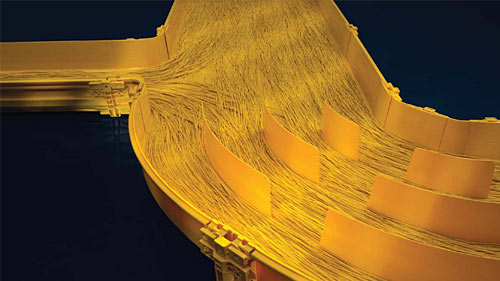
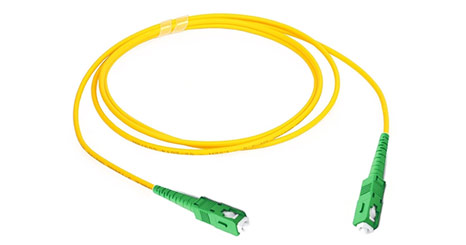
CommScope addresses this challenge with end-to-end fiber connectivity and cable management solutions designed specifically for high-density data centers. Its portfolio includes high-density panels, modular components, customized cable assemblies and FiberGuide® raceway systems that help operators keep pathways organized, accessible and easier to scale. The goal is not just neatness—it is also reducing risk, simplifying moves, adds and changes, and supporting efficient operations as networks become more fiber-intensive.
3. Building for speed without sacrificing accuracy
Cloud providers are under constant pressure to expand capacity faster. Time to deploy has become a competitive issue, especially as AI and hyperscale projects compress build schedules from years to months or even weeks. But faster deployments can introduce greater risk if installation is overly manual, documentation is inconsistent, or on-site labor requirements are too high. Labor availability and the complexity of modern architectures make this an ongoing challenge.
CommScope’s infrastructure approach is focused on simplifying deployment, slimming labor and skill requirements, and reducing errors. Preterminated and pre-labeled assemblies, modular designs and solutions like our Rapid Fiber Connect™ platform are designed to enable off site configuration, streamline installation and accelerate turn-up. For cloud data centers, that translates into a faster path to revenue, less dependency on scarce specialized labor and a more repeatable way to reliably deploy at scale.
4. Avoiding short-term decisions that limit future growth
Perhaps the most important challenge of all is future-readiness. Cloud data centers cannot afford infrastructure that meets today’s requirements but lacks the flexibility to adapt to the needs of tomorrow. Every investment in fiber connectivity and physical design must be evaluated not only for its initial performance, but also for how well it supports scaling, migration and technology shifts over time. This is especially important as AI, automation and new network architectures continue to reshape the data center landscape.
That evolutionary approach is central to CommScope’s culture of innovation. Across our data center infrastructure solutions portfolios, CommScope always aims to deliver flexible, modular, end-to-end infrastructure that helps operators evolve with confidence rather than rebuild under pressure. For cloud data center operators, that means choosing CommScope solutions can help support their high-density growth, simplify migration paths and reduce the operational friction that can come with rapid expansion.
Conclusion
The challenges facing cloud data centers are ultimately infrastructure challenges: higher density, faster speeds, more complexity, tighter deployment windows and greater pressure to operate efficiently while preparing for what comes next. CommScope addresses these challenges through innovative, scalable fiber platforms, cable management, modular connectivity and deployment-focused solutions built for high-performance, high-density environments.
To learn more about how CommScope helps data centers evolve and scale, visit our Empowering your AI Data Center page.