What Are the Challenges Facing Hyperscale Data Centers?
First, what is a hyperscale data center?
A hyperscale data center is a massive, highly scalable data center facility engineered to support cloud, AI and large-scale digital workloads through modular infrastructure, high-density compute and ultra-efficient networking, power and cooling systems.
Unlike traditional enterprise data centers, hyperscale environments are designed to scale horizontally—rapidly adding thousands of servers and incremental capacity on demand—while maintaining low latency, high throughput and operational efficiency.
These facilities typically power global cloud platforms, AI workloads and data-intensive applications that require high-speed fiber connectivity, automated operations and optimized space, power and cooling architectures.
Watch Video>> What is a HyperScale Data Center?
What challeges are hyperscalers facing?
Hyperscale data centers are under pressure to do more than simply add capacity. They also need to support AI-driven workloads, higher rack densities, faster migration to 400G, 800G and beyond, and constant expansion without creating bottlenecks in the physical layer. Today’s data centers are in a constant state of transition, where every infrastructure decision must balance immediate performance with long-term scalability. For hyperscale operators, that makes the cabling and connectivity foundation a strategic priority, not just an operational one.
1. Density and scale are increasing fast
One of the biggest challenges for hyperscale data centers is the sheer increase in compute density. AI clusters and cloud-scale environments can require tens of thousands of fiber connections, with GPU-rich architectures demanding more bandwidth in smaller footprints.
CommScope addresses this need with high-density fiber infrastructure designed for ultra-dense environments, including the Propel® high-density fiber platform and the Rapid Fiber Connect™ platform. These solutions help operators pack more connectivity into less space while preserving performance and maintaining a clear migration path for future speeds.
2. Speed migration must not disrupt growth
Hyperscale operators cannot afford infrastructure that solves today’s problem at the expense of tomorrow’s flexibility. As data center architectures evolve, the network must support ongoing migration from 400G to 800G, 1.6T and beyond.
CommScope’s ultra-low loss fiber cabling solutions are built to evolve and scale, giving operators a modular foundation that supports higher speeds over time. This flexibility is critical in hyperscale environments, where stranded investments or redesigns can lead to unwanted CapEx investments and incur deployment delays.
3. Deployment speed and installation accuracy matter
At hyperscale, even small installation errors can multiply quickly across rows, pods and clusters. At the same time, deployment windows are short and labor constraints are getting tighter all the time.
CommScope’s infrastructure solutions are designed to reduce complexity and accelerate turn-up through preterminated, pre-labeled and modular solutions. The Rapid Fiber Connect platform, for example, is purpose-built for AI data centers and simplifies cabling, testing, deployment and scaling through flexible panel designs and integrated pigtails that can be configured off site. That helps reduce manual work on site, lower the risk of installation errors and accelerate time to service.
4. Cable management becomes a performance issue
As hyperscale environments become denser, cable management is no longer just about neatness. It also directly affects airflow and thermal management, serviceability, moves, adds and changes, and long-term maintainability.
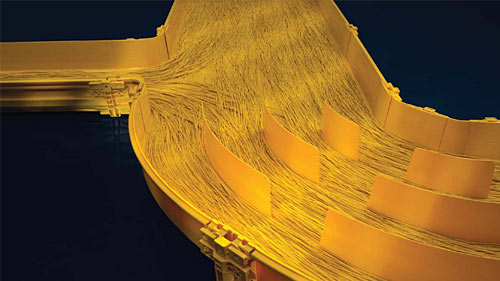
CommScope provides A range of horizontal and vertical cable management solutions, including the FiberGuide® fiber raceway system, our robust, completely customizable and scalable overhead solution designed to support growing footprints in scale-out upgrades. This broad portfolio helps hyperscale operators create organized, high-performance pathways between switches, servers and GPU racks.
Solving these challenges starts with infrastructure strategy
The challenges facing hyperscale data centers all point to the same conclusion: the physical layer must be designed for flexibility, speed and long-term growth. CommScope supports hyperscale, cloud and AI data centers with end-to-end fiber and copper infrastructure, high-density platforms, cable management systems, custom cable assemblies and expert support designed to help operators deploy faster and scale with confidence.
To learn more, visit Empower Your AI Data Center to Evolve and Scale.