
Author

Ken Hall, RCDD NTS
MPO connectors have quickly become the norm for data center cabling as they efficiently provide multiple fiber pairs in a single connector body between devices to support a wide variety of singlemode or multimode applications. With performance and fiber-to-fiber end-face alignment defined by industry standards, these multi-pair connectors enable parallel lanes to deliver increased capacity in a single connection.
MPO connectors were originally specified in 12- and 24-fiber configurations and were initially used for trunk cables between patch panels, which in turn were broken out in duplex connectors (such as the LC connector) for network electronics. Since then, MPOs are also available in standards of 16- and 32-fiber connectors in addition to the original 12-and 24-fiber versions.
Within international standards, IEC 61754-7 defines the MPO connector’s physical attributes, dimensions and intermateability. The fiber end-face geometry is governed by IEC 61755-3-31. For North America standards, TIA-604-5, also known as FOCIS-5, is the primary standard supporting physical compatibility between connectors.
The global industry standard MPO12 connector houses 12 fibers within a single body. Those 12 fibers are presented as a single row with fibers separated on 250µm centerlines with number assignments sequentially left to right, from 1 to 12. As network technologies have progressed with high-speed applications utilizing parallel optics, the MPO12 form factor has been used as the common interface for network connectivity at transceivers. Multi-pair applications at the transceivers typically use the outer pairs to separate transmit from receive. This provides separate electrical paths on the network equipment when the transceivers connect to the end device. Most common are 4- or 8-pair applications (such as 40G (4x10G), 100G (4x25G) or 400G (4x100G)).
So what’s MPO12/8?
For these applications, the common layout is to pair 4 transmit (Tx) fibers with 4 receive (Rx) from the outside in. While the standard connector is the MPO12, applications using 8 fibers are more precisely referred to as MPO12/8—because it defines the connecter (12) and the number of fibers it actually holds (8).
The center 4 fiber locations (of the 12 fiber positions) are not used, typically filled with fiber stub to prevent dust ingress, as you can see in the second example below.
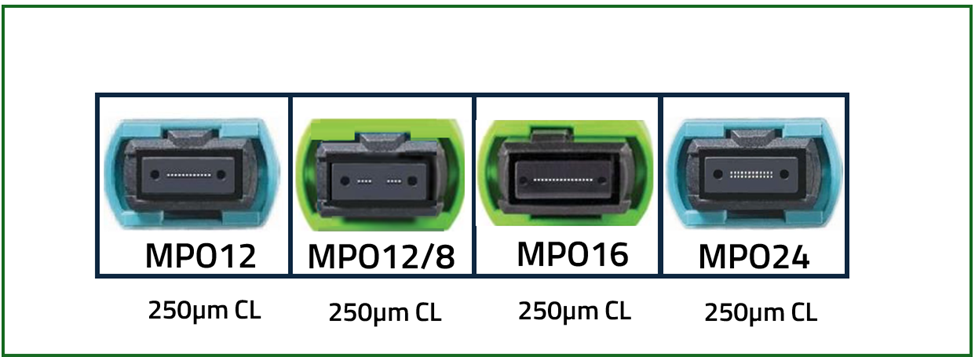
Why use 8 fibers in a connector able to accommodate 12? There are several reasons, in fact. For starters, it reduces waste by not defaulting to a 12-fiber cable which would be 1/3 unused. In addition, using fewer fibers reduces cable mass in crowded fiber pathways.
Applications such as 200Ghave also emerged using the outer 2 pairs (4 fibers total) for commonality and breakout simplicity using 2 100G lanes in each direction. Those connectors are precisely referred to as MPO12/4 to designate the use of the MPO12 connector and the fiber count (4) used for the application.
Whatever the fiber count, you can count on CommScope
CommScope is a trusted global provider of an entire MPO ecosystem of connectivity solutions, as well as those featuring MMC, LC, SC and ST (and soon, the upcoming FastSelfClean™ ultra-low loss, high density connector platform).
Though they are sometimes labeled elsewhere as MPO4 and MPO8, CommScope uses MPO12/8 and MPO12/4 to precisely identify both the connector and fiber count of those products in our detailed Ordering Guides, including our recent Data Center Cabling Solutions for NVIDIA GB200/GB300 NVL72 AI Architectures.
So while it turns out that there’s no difference between MPO8 and MPO12/8, there’s definitely a big difference in where you get your high-performance data center fiber infrastructure.
© 2026 CommScope Technologies LLC, an Amphenol company. All rights reserved. CommScope and the CommScope logo are registered trademarks of CommScope and/or its affiliates in the U.S. and other countries. For additional trademark information see https://www.commscope.com/trademarks. All product names, trademarks and registered trademarks are property of their respective owners.


