
Author

Jason Reasor
Categories
Enterprise Wi-FiCommScope’s research reveals four key trends and some eye-opening insights impacting enterprise building and campus networks:
- Hyperconnectivity
- Bandwidth
- Power
- Design adaptability
During this four-part mini-blog series, we’ll highlight each issue and discuss the implications on your physical layer infrastructure. Additionally, we’ll provide tips on how to better plan and design for emerging next-gen applications.
How much bandwidth?
Our last mini-blog focused on the far-reaching effects of hyperconnectivity in the enterprise network. Today, we’ll look at one of those effects: the need for more bandwidth. This is really a two-part issue, beginning with how to quantify how much bandwidth is needed.
As we know, bandwidth demand in the enterprise has been on a continuous upward trajectory. A 2020 report[i] from Wakefield Research estimated that 69% of companies (and 92% of top-tier data culture companies) have a corporate initiative to become more data driven. The IoT devices generating much of this data will generate over 90 ZB by 2025.[ii]
But that’s only part of the story. Increases in the network’s ability to handle higher data loads lead to more bandwidth-hungry applications. For example, the recent introduction of Wi-Fi 6E and the dawning of Wi-Fi 7 are sending current and projected demand for data into the stratosphere.
Whereas Wi-Fi 6 operates on 24 channels, Wi-Fi 6E adds 109 additional channels in the unlicensed 6 GHz band. Wi-Fi 7, which uses 4096-QAM modulation, will take capacity and speed even further.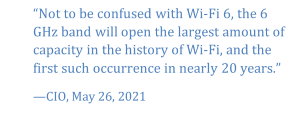
Other bandwidth-intensive applications include high-resolution video, backhaul for distributed antenna systems, artificial intelligence, building management and automated control systems.
From backbone to edge
The second part of the challenge is ensuring your network infrastructure can handle the data surge. Much of the network’s design depends on where data is generated and where it must be processed and stored. We know that more network activity is being moved out to the edge and up into the ceiling. Where data demands eclipse gigabit speeds, the number of cabling alternatives that can run more than a few meters shrinks considerably. For applications requiring more than 5GE capabilities, only Category 6A is up to the task.
A little advice
To help you develop more capacity and reliability in your enterprise network, CommScope offers the following guidance:
- First and foremost, if you have not yet begun a transition to a Category 6A cabling platform, it’s time to give it some serious thought. Category 6A is the only Ethernet option that can support 10GBASE-T to 100 meters—satisfying your current bandwidth demands while leaving plenty in the tank.
- Whatever efforts and resources you’re currently investing in bandwidth planning, increase them. So long as new technologies continue to flood the market, demand will remain fluid. The increase in machine-to-machine communications is actually a stabilizing factor, as machine-generated traffic tends to be more predictable.
- If you decide to go all-in on Category 6A, look for opportunities to leverage its ability to support four-pair power over Ethernet (up to 100 watts). With the use of higher-wattage connected devices rising, Category 6A enables you to converge your data and power onto a single cable.
And speaking of power, stay tuned for Part 3, where we’ll discuss the power dynamics of a hyperconnected enterprise. See you then.
[i] The Alation State of Data Culture Report; Wakefield Research (funded by Alation Inc.); Q3 2020
[ii] 175 Zettabytes By 2025; Forbes, blog; November 27, 2018